Christmas 1945 by Peggy Scholberg
- ann615
- Dec 25, 2025
- 6 min read
Whenever Silent Night was sung on Christmas Eve, my mother would always start sobbing, as she reminisced about her friend Krystyne.
In December, 1945, the war was over and the Hospital staff waited to go home or be reassigned. Krystyne, a displaced person from Poland, worked in the kitchen. Kathy and Krystine had become friends, and helped each other to learn languages.
Read further in the book further to find out a soldier’s very different interpretation of the Christmas Eve sermon. Hear Krystyne’s surprising response to Kathy’s invitation to go home with her to the States.
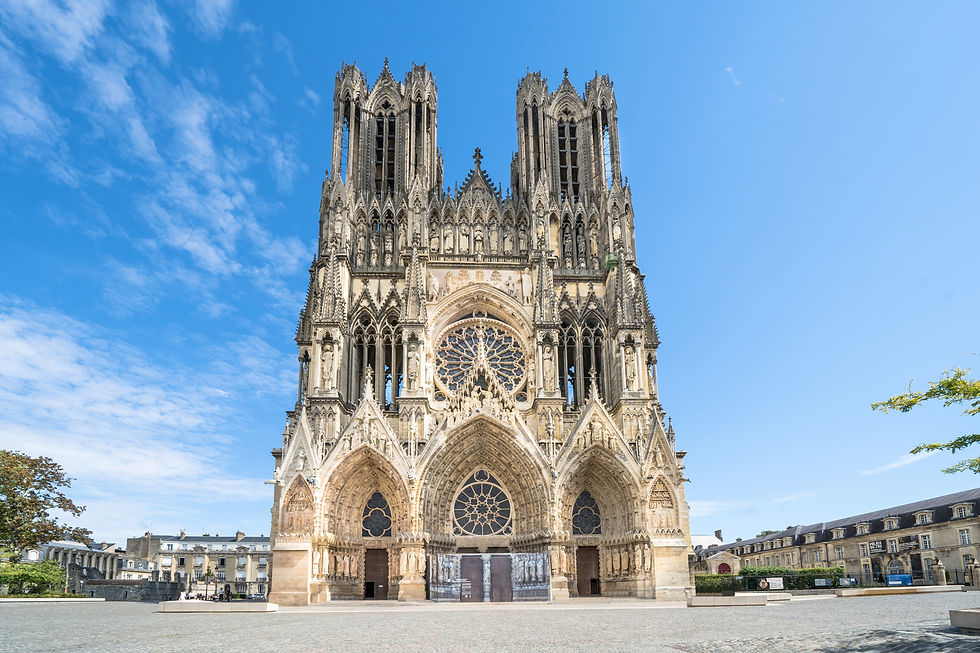
Reims Cathedral of Notre Dame
Book Excerpt:
The afternoon before Christmas they gave a party for the local orphans. They showed movie cartoons, understood in any language, and gave the children apples and fancy cookies and PX candies. The children watched seriously, silently. They each ate one cookie and one candy, and stuffed the rest in their pockets. Even at their young age they knew that they had to save for the morrow, where there would be no more goodies. The party, intended to make the orphans merry, could not rouse any shouts of joy or laughter in these weary children. This was not enough, not nearly enough.
On Christmas Eve they gave a dinner for everyone who worked in the mess. There were French, Polish, Russians, Germans, and Americans. White sheets were spread as tablecloths. Kathy placed the most beautiful of decorations—food—down the center of the table in between pine branches. Together they enjoyed eating red apples and oranges, brown walnuts and pecans, pumpkin pies and mince pies, and round bowls of shimmering cranberry sauce and strawberry preserves.
All food was placed on the table so that all could eat together, and no one had to serve. Fresh turkey had been flown in from the States for the Christmas feast. There were bowls of mashed potatoes and brown gravy, peaches, cherries and pineapple, candied carrots and sweet potatoes, and fresh hot rolls with butter and raspberry jam.
Each said his own grace in his own language, or simply bowed his or her head. Kathy sat across the table from Krystyne. They ate and talked, and it didn’t matter whether the words were understood or not, the good will flowed in happy communication. Kathy could say to a Russian, “This turkey is good,” and the Russian could nod an enthusiastic “Da,” with some other words that clearly said, “Yes, this is good.” In minutes everyone had learned to say “Merry Christmas” in every language, and all the accents were good ones.
Near the end of the meal, while a few were enjoying eating their pie, someone began singing Christmas carols. Singing “Deck the Halls with Boughs of Holly” the words were mixed, but the tune was the same for all, and the “fa la la, la la’s” were universal. In “Oh Little Town of Bethlehem,” the language differences were forgotten and the vowels blended together in glorious harmony. The war was ended, in peace they blended in friendship and good will.
The singing of “Silent Night, Holy Night,” with the long, smoothly flowing harmonized vowels—“si-il, nt night, ho-oly night”—was inspired. “A-all is calm, a-all is bright.” This was Christmas.
Kathy looked across the table to share this beauty with Krystyne. Krystyne’s eyes were shimmering blue. The tears over-flowed down her cheeks to drip onto her shabby blue sweater. The song was suddenly irony. What was calm, what was bright for Krystyne?
Krystyne should not return to her room alone among people whose language she could not speak. Kathy planned to go into Reims to the midnight mass at the Cathedral. The Chaplain had ordered an Army truck to make the trip. Kathy spoke to Krystyne in German, inviting her to come along and spend the night with Kathy.
Two Red Cross girls and twenty GIs went along with Kathy and Krystyne. The ride in the canvas-topped truck was cold. Inside, the Cathedral seemed even colder, sitting among cold stones. The stained-glass windows had been so brilliant when the light of the day shone through. In the dark night, the windows were a dull gray framed in leaden black. A harsh light glared from bare electric light bulbs hung by long black wires from the vaulted roof, deepening the shadows in the walls damaged with bullet holes.
There were no evergreens, no poinsettias, no banks of warm candles along the walls. The Cathedral seemed a pile of cold stones and statues. The candles on the altar were feeble under the glaring light bulbs. When the choir sang, their music was overwhelmed by the shuffling of people, their sneezes, sniffles, and coughs. The bishop’s magnificent gold-and-purple embroidered robes, and the red-robed acolytes swinging a smoking incense burner, seemed out of place.
Suddenly, the electricity went off. The electric light bulbs faded. The organ music dwindled to silence. In the darkness, the candles on the altar glowed warmly and brightly. The silver cross above the altar seemed to float, gleaming in the darkness. The congregation caught its breath in the wonder of the light in the darkness. The shuffling and coughing stopped. Now, only the music of glorious singing filled the church.
Flashlights were silently switched on. Their beams followed fluted columns up till they blended into the heavens above. Beams of light picked out statues that seemed to rise out of the darkness. Apostles and saints soared in light.
Kathy remembered the words heard in Episcopalian services all her life, “...therefore with Angels and Archangels, and with all the company of heaven.... Glory be to thee, O Lord Most High.”
The bishop was escorted up the circular stairway to the pulpit by acolytes carrying candles. They left him in darkness alone in the pulpit. He began to speak, and his voice seemed to come not from this world, but out of the darkness above. His deep voice rolled out over the unseen congregation.
“The war is ended. We can again know peace on earth. Good will toward men makes peace on earth. Peace doesn’t just happen; it is made. Now is the time in which we are to live and to act. Do you know what forces we could unleash in so many areas with the love and service of our fellow man?
“There are some 500 people here tonight. What an impact we could have. We could change history. We could make history.
“We can do it. This is our hope. This is our joy. This is the Christmas hope and the Christmas joy—because, after all, what we are celebrating tonight is the way God changed history with just one man.”
The choir sang the jubilant “Handel’s Messiah.” Krystyne and Kathy joined the French singing the universal “Alleluia.” The echoes of music faded, and the congregation knelt for the final benediction. “The peace of God, which passeth all understanding, keep your hearts and minds in the knowledge and love of God, and of his Son Jesus Christ our Lord; and the blessing of God Almighty, the Father, the Son and the Holy Ghost, be amongst you and remain with you always. Amen.”
Krystyne stayed on her knees a few minutes in silence.
She turned to Kathy, kneeling beside her, and spoke in a quiet, serious voice. “After my mother died...in the work camp...after they killed my mother, I hated. I knew I too would die. I could not endure. A nine-year-old boy had been in that hungry camp three years. He said to me, “Pray. Forgive. Live.” I prayed. I forgave. I lived.”
The congregation brought their flickering flashlights beams down from the vaulted ceilings and statues to the floor, to light their way out. The two Red Cross girls left the cathedral through the center door, passing under the benediction of L’Ange au Sourire. The Angel of the Smile. They smiled back at the angel. Her snow cap sparkled in moonlight. Ridges of snow heightened the folds of her robe. Her wings, edged in snow, were luminous. The stars shone so brightly in the sky over the cathedral that Kathy could imagine a star in the east gleaming above the rest. Krystyne stood under the angel, her head tilted at the same angle, smiling the same smile.
The men in the truck offered helping hands to lift the girls in. Two men stood to offer them seats, one seat on each bench on opposite sides of the truck. Sitting closely together, they warmed each other, and the atmosphere was not so chilling.
From the open back of the truck, the charming village houses and rolling hills were peacefully covered with white snow. Bomb-shattered rubble was hidden under mounds of soft snow. Rows of round tents, covered with snow, blended in with the hills. The moonlight sparkled on the snow on tents, hills and houses alike. The heavens were starred and the earth was white, except where the Army truck left two black lines on the road.


Comments